 English
×
Search
A reliable bathroom hardware manufacturer is not defined only by competitive pricing or a large product catalogue. For global buyers, a trustworthy supplier should demonstrate consistent manufacturing capability, strict quality control, reliable material management, engineering support, flexible customisation ability, and long-term supply stability.
When sourcing bathroom accessories for hotels, residential developments, distributors, retailers, and construction projects, buyers need more than finished products. They need a manufacturing partner that can control every stage from product design and material selection to production, inspection, packaging, and after-sales support.
The difference between an ordinary supplier and a reliable manufacturer often becomes visible after large-scale production begins. Consistent finishes, accurate dimensions, stable delivery schedules, and responsive technical communication are what protect a project from costly delays and quality issues.
A professional supplier should be evaluated based on manufacturing capability rather than marketing claims.
The key factors include:
Production experience and industry expertise
Control over critical manufacturing processes
Material and component traceability
Surface finishing capability
Quality inspection systems
Customisation and engineering support
Export experience and project coordination
Long-term product availability
A manufacturer capable of supporting international buyers should understand that different markets have different expectations regarding design trends, installation methods, quality standards, packaging requirements, and compliance considerations.
For example, a hotel project in Europe may prioritise premium finishes and sustainability requirements, while a public facility project may focus more on durability, maintenance efficiency, and vandal-resistant design.
A capable bathroom hardware manufacturer should be able to adapt its production solutions according to the final application.
Manufacturing capability directly affects product consistency, delivery reliability, and long-term cooperation.
Many suppliers can provide samples, but large-scale production requires much stronger control.
A professional manufacturer should have experience managing:
Product mould development
Die casting processes
CNC machining
Metal forming
Injection moulding
Polishing and surface treatment
Assembly processes
Quality inspection
Packaging management
These capabilities allow manufacturers to maintain better control over product performance and appearance.
For global buyers, this is particularly important because commercial projects often require hundreds or thousands of identical products. A small variation in dimensions, colour, or surface texture may become a major issue when products are installed across multiple rooms or buildings.
A manufacturer with integrated production capabilities can reduce dependence on external suppliers and improve consistency throughout the supply chain.
Quality control is one of the most important differences between a reliable manufacturer and a trading company.
Bathroom products operate in challenging environments. They are exposed to:
Continuous moisture
Frequent cleaning
Temperature changes
Daily mechanical use
Chemical exposure from cleaning agents
Therefore, quality inspection should not only focus on appearance.
A complete quality-control system should include:
Materials such as stainless steel, brass, zinc alloy, plastics, and surface-treatment components should be checked before production.
Material consistency affects:
Strength
Corrosion resistance
Surface appearance
Product lifespan
During manufacturing, key dimensions and production parameters should be monitored to prevent defects from reaching final assembly.
Important checkpoints may include:
Component dimensions
Thread accuracy
Assembly performance
Surface defects
Structural stability
Before shipment, finished products should be inspected for:
Appearance consistency
Function testing
Installation compatibility
Packaging condition
Quantity accuracy
For international buyers, these inspection procedures reduce the risk of receiving products that do not match approved samples.
Material selection directly influences product durability, appearance, and maintenance requirements.
A professional manufacturer should understand the advantages and limitations of different materials.
Stainless steel is commonly used for bathroom hardware because of its corrosion resistance, strength, and suitability for humid environments.
It is frequently applied in:
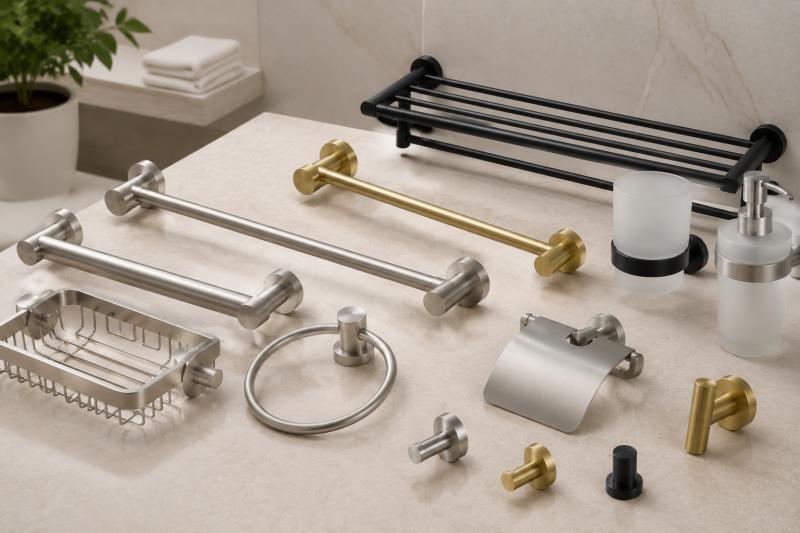
Towel bars
Shower shelves
Grab bars
Bathroom hooks
Commercial accessories
Different stainless steel grades may be selected depending on the environment and performance requirements.
Brass is widely used in premium bathroom applications because it provides excellent machining performance and supports various decorative finishes.
It is suitable for products requiring:
Complex designs
Premium appearance
Decorative coatings
High-end project aesthetics
Zinc alloy provides manufacturing flexibility and cost efficiency, especially for decorative components with complex shapes.
It is often selected for:
Hooks
Handles
Small fittings
Decorative accessories
A reliable bathroom accessories supplier should not simply recommend one material for all products. Instead, the manufacturer should evaluate the application, environment, expected lifespan, and project budget before recommending a solution.
Surface finishing is one of the most visible indicators of manufacturing quality.
Two products made from the same base material can have very different performance depending on the finishing process.
Common finishes include:
Chrome
Brushed nickel
Matte black
Brushed brass
Polished brass
PVD coatings
A professional manufacturer should control:
Surface preparation
Coating process
Colour consistency
Adhesion performance
Scratch resistance
Corrosion resistance
For large hospitality or residential projects, finish consistency is especially important.
A hotel bathroom may contain dozens of different accessories. If towel bars, hooks, shelves, and other components have slightly different colours or textures, the final installation quality may appear inconsistent.
Reliable manufacturers normally establish approved samples and production standards before mass manufacturing begins.
Yes. For many global buyers, customisation capability is a key factor when selecting a long-term supplier.
Customisation may include:
Product dimensions
Material selection
Surface finishes
Logo branding
Packaging design
Installation structures
Special project requirements
OEM and ODM capability is especially valuable for:
Bathroom brands
Distributors
Hotel groups
Construction companies
Interior design companies
However, effective customisation requires more than changing product appearance.
A capable manufacturer should provide engineering support to evaluate:
Production feasibility
Material suitability
Cost optimisation
Tooling requirements
Manufacturing timeline
This helps buyers avoid designs that look attractive but create production problems.
International purchasing involves more than manufacturing.
A reliable export-oriented manufacturer should understand:
International packaging standards
Shipping requirements
Documentation processes
Different market preferences
Communication efficiency
Project timeline management
Global buyers often face challenges caused by:
Incorrect product labelling
Missing installation components
Inconsistent cartons
Delayed documentation
Poor after-sales communication
An experienced manufacturer understands these risks and establishes processes to prevent them.
For large projects, export experience can significantly reduce coordination costs.
Before starting cooperation, buyers should evaluate the supplier carefully.
Important evaluation points include:
Factory visits, production videos, or third-party inspections can help confirm actual production capability.
Samples should represent the same materials, finishes, and production processes used for mass orders.
Ask how the manufacturer controls:
Raw materials
Production processes
Finished products
Packaging
Customer complaints
A reliable supplier should provide clear answers regarding:
Technical questions
Production schedules
Customisation requirements
Quality issues
Good communication is especially important for overseas buyers because cooperation usually involves different languages, time zones, and business practices.
Before placing an order, global buyers should ask:
What manufacturing processes are completed in-house?
What materials are used for each product category?
Can you provide material specifications or test reports?
How do you maintain finish consistency between production batches?
What quality inspections are performed before shipment?
Can you support OEM and ODM projects?
What is your typical production lead time?
How do you handle replacement parts and after-sales support?
Can you provide packaging solutions for international shipping?
How do you ensure product quality during large-volume production?
The answers to these questions reveal whether the supplier is prepared to support long-term cooperation.
A good manufacturer combines strong production capability, reliable quality control, consistent finishing, engineering support, flexible customisation, and stable export experience.
The best choice depends on project requirements. For standard products, trading companies may provide convenience. However, for customised products, large orders, and long-term cooperation, working directly with an experienced manufacturer usually provides better control over quality and production.
Buyers should evaluate material specifications, manufacturing processes, surface treatment quality, inspection procedures, samples, and production consistency rather than judging only by appearance or price.
Certification requirements depend on the target market and product category. Buyers should confirm applicable standards, testing requirements, and documentation before purchasing.
Yes. Experienced manufacturers can support customised designs, finishes, packaging, branding, and project-specific requirements through OEM and ODM services.
Selecting the right bathroom hardware manufacturer is a strategic decision that affects product quality, project efficiency, customer satisfaction, and long-term business growth.
For global buyers, the ideal supplier is not simply the one offering the lowest quotation. A reliable partner should provide manufacturing expertise, strict quality control, material knowledge, customisation capability, and dependable international service.
With the right manufacturing partner, businesses can achieve consistent product quality, reduce supply-chain risks, and build competitive bathroom accessory solutions for different markets.
Do you have questions or comments about any of our bathroom hardware & slow close toilet seat? We want to hear from you.
Suite 2206, No. 888 North Sichuan Road, Shanghai, 200080, China